
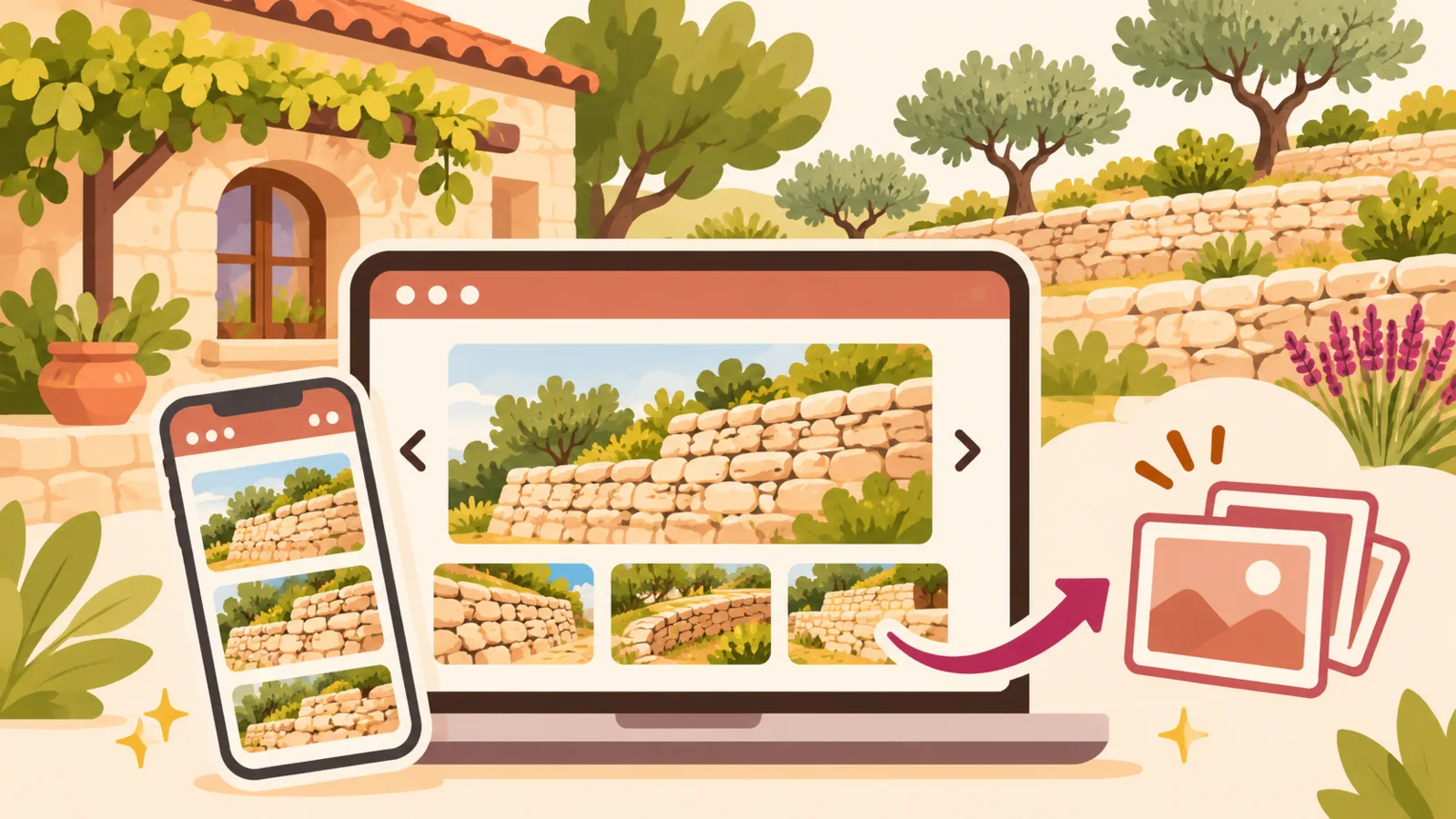
Why showcase your work online?
For a stone heritage restoration specialist, photos can show skills that are difficult to sum up in a few lines. Potential clients can look at rebuilt dry-stone walls, a restored stone-paved path or a repaired terraced retaining wall, then see what kinds of projects you take on.
A well-documented portfolio does more than show the finished result. It also helps explain the challenges involved, the techniques used and the materials chosen. That’s useful from the first contact, especially when a client is deciding between a traditional repair and work using modern materials.
Document each project, not just the finished result
For each project, choose a few clear images: an overall view, close-ups of the structure and, if possible, photos taken before, during and after the work. Ask the client for permission before publishing photos of their property, and avoid showing personal information.
Add a short caption to provide context:
- Structure: retaining wall, terraced retaining wall, steps or stone-paved path.
- Work carried out: repairing a collapse, rebuilding part of a wall or restoring a path.
- Technique: for example, dry-stone construction without cement-based binder, if that is what was used.
- Context: type of stone, slope, site access or conservation requirements.
- Area: town or service area, without revealing a private address.
For example, a project description could cover the repair of a collapsed section of terraced retaining wall on sloping ground: dismantling unstable sections, sorting and reusing the available stones, then rebuilding the wall dry. This describes the work without suggesting that every project follows the same process.
Highlight traditional skills and technical choices
Dry-stone construction involves arranging stones without mortar. Present it as a traditional technique and explain what it brings to the specific project. Depending on the structure and the terrain, drainage, stone selection and how the stones are assembled all play a part in the stability of the finished work.
For a stone-paved path, for example, show the surface stones and the joins with the edging. For a wall, include details of the stonework pattern, corners or connections to an existing structure where possible. These images give clients who may not know the trade’s terminology something concrete to look at.
Avoid broad claims such as “a solution for every wall.” Instead, explain that the right technique depends on the condition of the structure, the materials available and the site constraints. If cement or another binder was used on part of the project, say so precisely rather than presenting the work as entirely dry-stone construction.
Make your portfolio easy to browse
You can share your work on an external platform, such as Instagram or Houzz, or present it in a space you manage. Choose a platform you can keep up to date, where photos are easy to find. A Google Maps profile can help people learn about your business and service area; Travaux.com may also be relevant if you actively present your services there.
A QLII mini-site can bring together useful links to these pages, your professional profile and your contact methods. It acts as a starting point for the platforms where your work is displayed: it doesn’t replace an external portfolio or provide a built-in project gallery.
Use clear link labels, such as “View restored walls” or “See projects on Instagram,” instead of listing URLs without explanation. Also check that linked pages are accessible and up to date.
Share the information clients need before requesting a quote
A portfolio helps potential clients assess your work, but they also need to know whether their project fits your business. Clearly state:
- the structures you restore, such as stone walls, terraced retaining walls or stone-paved paths;
- the towns or areas where you work;
- how to contact you and what information to provide for an initial discussion;
- your availability, only if it is current;
- any qualifications, insurance or certifications you hold, with a verifiable link where available.
You can invite clients to send a few photos, specify the town and describe the issue they have noticed. This doesn’t replace a site visit when one is needed, but it makes the first conversation more specific.
FAQ
How many projects should I showcase?
It’s better to start with a few well-documented projects than to publish lots of photos without context. Add new examples when you have relevant images and permission to share them.
Should I publish the prices of my work?
Not necessarily: the cost depends on factors such as the condition of the structure, site access, available stones and the amount of work required. Instead, explain how to contact you to describe the project and request an estimate.
Can I show before-and-after photos?
Yes, if you have the client’s permission and the images help people understand the work. A caption explaining what you did avoids implying that all the visible changes were solely the result of your work if other work was also carried out.